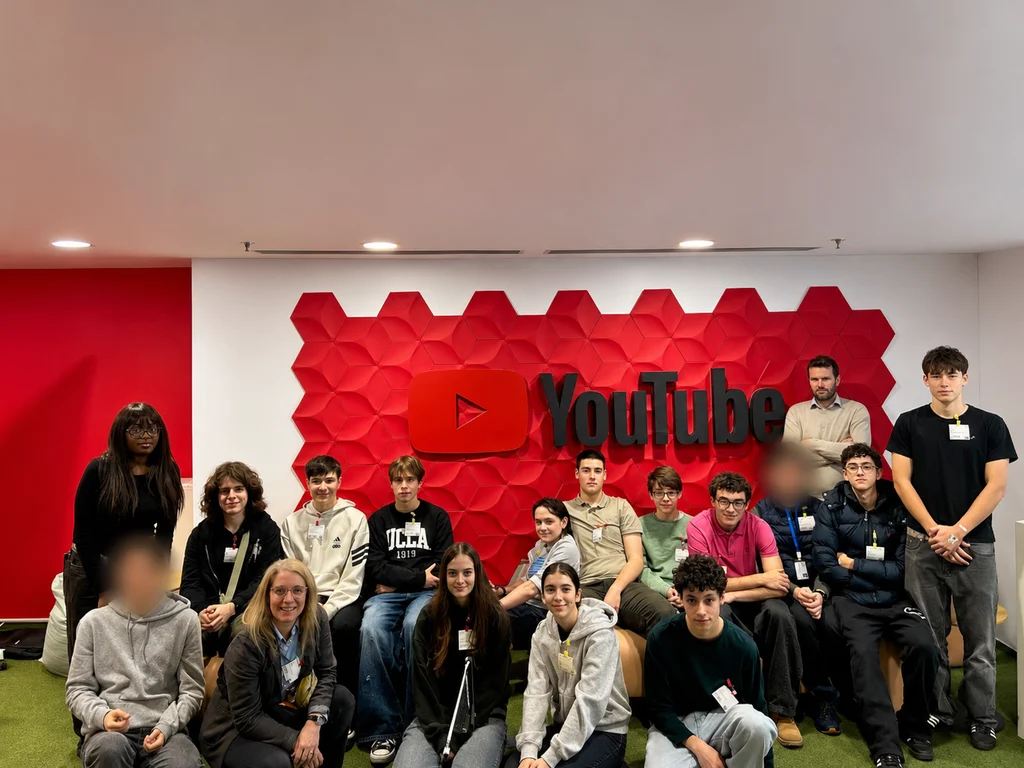

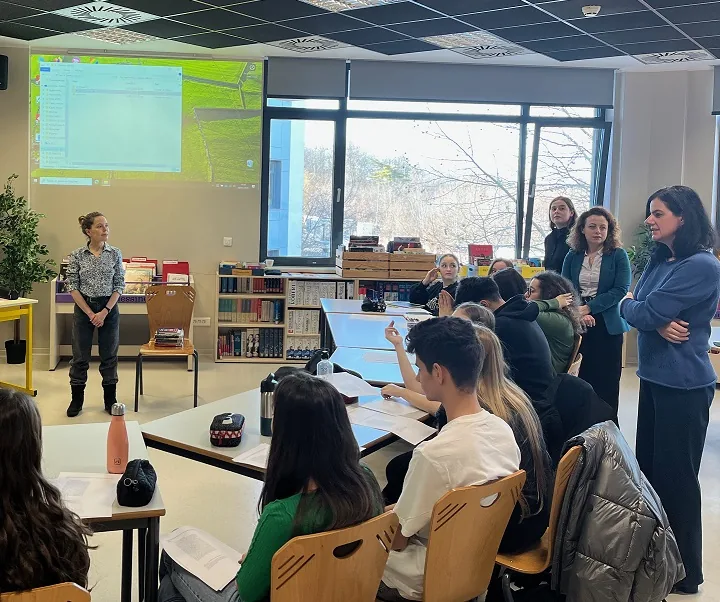
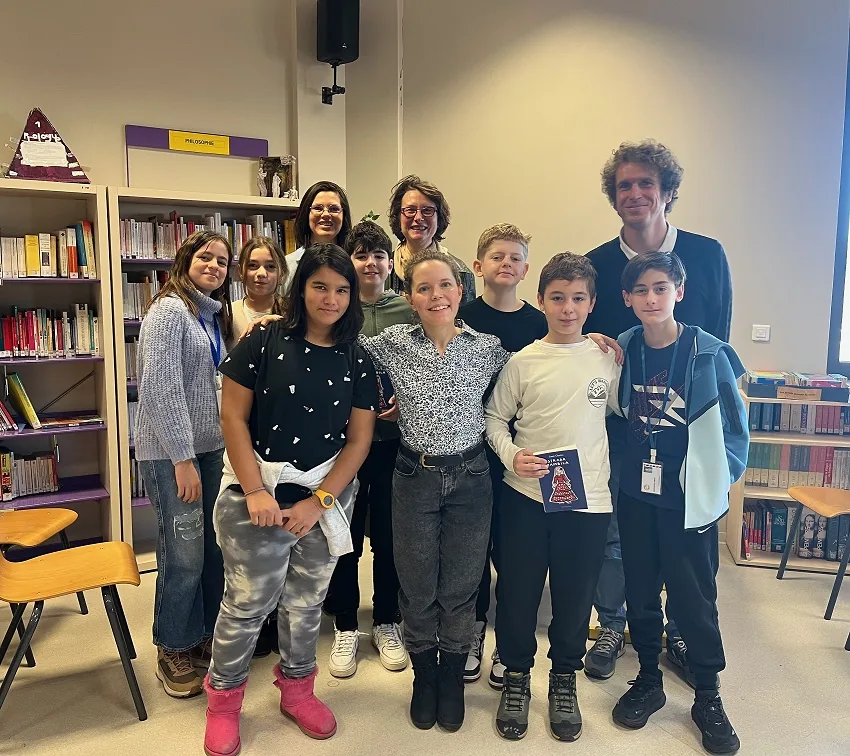
The name Fanny Chartres might mean something to you. She worked as a documentary filmmaker at the high school and in the cultural service of the French Embassy here in Bucharest. She also translated Romanian literature into French. Today she writes novels. We received her on the occasion of the release of In the belly of Fianna Sinn, Fanny met with Ms. Robert's sixth graders for a Q&A session about the book. Strada Zambila that they had all read them. Then, with Ms Parrique’s 5th graders, we participated in a poetic writing workshop based on photographs of Bucharest taken by the students themselves. The idea was to look at Bucharest by re-interrogating the notions of beautiful and ugly. An exhibition of their works is currently being prepared. Finally, a translation workshop was held with all the students studying Romanian in high school. It was a day rich in emotions.
Testimonies from students following this encounter
I will remember that she told us how she wrote her first novel Strada Zambila She told us that when she wrote the book, she lived in Romania. The story is fictional.
I am very happy to have met her because you don’t meet a writer every day.Milan).
I will remember That was a very good moment. I really enjoyed this book. So I wanted to see the person in person. Besides, I hadn’t looked up any information about Fanny Chartres on the internet. That’s why I wanted to see her. I really liked asking her questions. She was very kind. I really liked her imagination for all her books. This book also made me want to read more because before I really didn’t like reading. I also liked it because she wrote us a dedication. It touched me. Now I read at least one chapter a day. I loved it when she said that she was inspired by the landscapes of Romania and how long it took her to create this book. (Yanis)
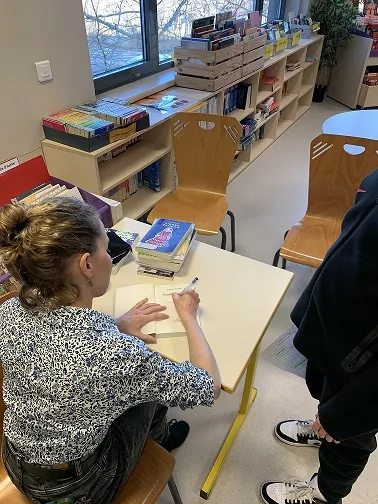
I will remember Always from this encounter with Fanny Chartres. It’s not every day that you meet a writer. She was kind and polite. She told us how she had written the book. She also told us about her life and especially how she started writing. Then she signed our books. (Ayana)
I will remember We asked her a lot of questions. She told us how she created the story. And at first, Albert and I gave the information we found on the internet. Everything was true. (Ana)
I will remember that she was kind and polite. She told us how she wrote Strada Zambila She also autographed our book. She explained that she has written several books, why she came to Romania and she answered all our questions. (Anahita)
I will remember From what she said: how the book was created and produced, how she learned Romanian and how she started writing. The French high school where she worked closed for a week because of the snow. So, she started writing J’étais très surpris car maintenant, ce n’aurait pas été possible because there is no more snow. I enjoyed this meeting because she really explained how Albert and Ana’s research on the internet was real. She was also happy because the translated book in Romanian did well in Romania. (Vlad)
I will remember that she was kind to us and that she answered all our questions. I appreciated it when she wrote a dedication on our book. On my Romanian book, she added my mother’s name because she had also read the novel. I loved it when she told how she had created the story: there was too much snow for several days to go to work at the high school. And at that moment, the idea came to her to write. She finished Strada Zambila In two months, he reworked it for four months before publishing it. This therefore required six months of work. It was his first novel.Albert)
Article written by the students
INTALNIRE WITH FANNY CHARTRES
Fanny Chartres doesn’t reveal her secrets: the art of translation and the joy of writing an engaging novel…
In a beautiful afternoon, the 2nd gradersnde If Terminale, framed by the Romanian teachers (Ms. Babos, Ms. Negoita and Ms. Georgescu), had the opportunity to meet the writer and translator Fanny Chartres, this event took place within the Mediateca of the French High School, on Tuesday, January 28th.
Throughout the first hour, Fanny Chartres was kind enough to answer the students« questions and satisfy their curiosity. Thus, we learned how much she loves Romania and the Romanian language and how she came up with the idea to write her first novel, »Strada Zambila”. As for the translations from the Romanian language, she revealed the criteria behind her choices as a translator: engaging subject matter, strong characters, beautiful style, and not least, the emotion conveyed.
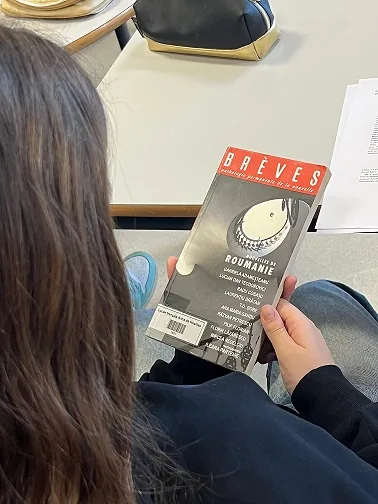
The second hour was dedicated to a workshop on translating fragments from his novels from French into Romanian. The students, working in groups, were curious to discover more translation options and the translator’s opinion.
Here are some comments from the 2nd graders about this event:
- I was drawn, but also put in difficulty, by choosing the right words so as to express the idea of the given text as appropriately as possible. I didn’t know that it was so difficult to translate a text.
- I was amazed to discover the joy with which the writer spoke about her works.
- I was impressed by the love the writer Fanny Chartres has for Romania and how well she masters the Romanian language.
- I was impressed by the themes addressed in his novels (the process of uprooting and the emotional difficulties) and the subtle way in which his novels manage to convey them.
- It would also be nice to discuss more about her personal life and how it is reflected in the novels she writes.
MEETING WITH FANNY CHARTRES
Fanny Chartres reveals her secrets: the art of translation and the joy of writing an engaging novel…
On a beautiful afternoon, the students of Second and Terminale, accompanied by their Romanian teachers (Ms. Babos, Ms. Negoita and Ms. Georgescu), had the opportunity to meet the writer and translator Fanny Chartres. This event took place at the Lycée Français Library on Tuesday, January 28th.
During the first hour, Fanny Chartres was kind enough to answer the students’ questions. This is how we discovered how much she loves Romania and the Romanian language, as well as the origin of the idea for her first novel, Strada Zambila. Regarding the translations from Romanian, she revealed the criteria that guide her choices as a translator: a captivating subject, strong characters, a beautiful style and, above all, the emotion conveyed.
The second hour was devoted to a translation workshop of some excerpts from his novels. The students, working in groups, were curious to discover several translation variants and the translator’s opinion.
Here are some impressions of the Second Year students about this event:
«I would also have liked to discuss more about her personal life and how it is reflected in her novels.»
«I was both fascinated and challenged by the choice of the right words to best express the idea of the given text. I didn’t know that it was so difficult to translate a text.»
« I was surprised to discover the joy with which the writer spoke about her works. »
« I was impressed by the love that the writer Fanny Chartres has for Romania and by her mastery of the Romanian language. »
«I was touched by the themes addressed in his novels (uprooting, emotional difficulties) and by the serene way in which his novels manage to convey them.»